English
 русский

Content
- 1 How Heavy Is a Crusher Cone? The Two Numbers Buyers Actually Need
- 2 Which "Cone" Are You Weighing? Three Different Numbers
- 3 Cone Crusher Weight by Machine Size
- 4 How Much Does a Mantle Weigh on Its Own?
- 5 What Makes One Cone Crusher Heavier Than Another
- 6 Weight Distribution Inside a Cone Crusher
- 7 Tonnes per Hour per Tonne of Machine: A Useful Selection Benchmark
- 8 Weight and Freight: Containers, Flat Racks and Break Bulk
- 9 Foundations, Dynamic Loads and the Crane You Will Actually Hire
- 10 What Machine Weight Means at Wear-Part Changeout
- 11 Net Weight, Gross Weight and How to Verify a Quoted Figure
- 12 Motor Power, Energy Cost and the Weight-per-kW Ratio
- 13 Cone Crusher Weight Inside a Complete Crushing Plant
- 14 Eight Weight-Related Risks in a Cone Crusher Quotation
- 15 FAQ: Cone Crusher Weight Questions
- 15.1 How heavy is a crusher cone?
- 15.2 How much does a cone crusher mantle weigh?
- 15.3 Is a heavier cone crusher always better?
- 15.4 Can a cone crusher fit in a 20 foot container?
- 15.5 How much does a 1200 mm cone crusher weigh?
- 15.6 What crane capacity do I need to install a cone crusher?
- 15.7 Does the cavity type change the machine weight?
- 15.8 How do I verify the weight I have been quoted?
How Heavy Is a Crusher Cone? The Two Numbers Buyers Actually Need
A 600 mm cone crusher weighs about 5.5 to 7.5 tonnes. A 1200 mm machine lands between 22 and 27 tonnes. A 2200 mm machine runs 75 to 90 tonnes. If the question is about the crushing cone itself, the manganese mantle on a mid-size 1200 mm unit usually weighs 600 to 1,000 kg, while the mantle on a 2200 mm machine can pass 4.5 tonnes.
Both answers are correct, because "crusher cone" is used for two different things in the trade. Freight forwarders and rigging crews mean the complete machine. Maintenance planners mean the moving cone assembly: the head, the mantle and the hardware that locks them together. Foundation engineers need both, plus the weight of every sub-assembly they will lift separately.
| Cone diameter | Complete machine | Crushing cone (head + mantle) | Bowl liner set | Typical motor |
|---|---|---|---|---|
| 600 mm | 5.5 - 7.5 t | 180 - 320 kg | 150 - 300 kg | 30 - 37 kW |
| 900 mm | 10 - 13 t | 350 - 600 kg | 300 - 550 kg | 55 - 75 kW |
| 1200 mm | 22 - 27 t | 600 - 1,000 kg | 550 - 950 kg | 110 - 160 kW |
| 1650 mm | 38 - 52 t | 1,800 - 2,600 kg | 1,600 - 2,400 kg | 220 - 280 kW |
| 1750 - 1800 mm | 45 - 55 t | 2,000 - 3,000 kg | 1,800 - 2,800 kg | 250 - 315 kW |
| 2100 - 2200 mm | 75 - 90 t | 3,000 - 4,800 kg | 2,800 - 4,500 kg | 315 - 400 kW |
Treat that table as a quotation filter rather than a specification. If a supplier quotes a 1200 mm machine at 15 tonnes, either it is a genuinely lighter frame design than the category norm, or the figure refers to a bare frame without motor, drive guard, hydraulic power unit, lubrication station and base. Both are possible. Neither is what you need when you are booking freight or ordering a crane.
Which "Cone" Are You Weighing? Three Different Numbers
Before you compare figures from two suppliers, agree on what is being weighed. In practice there are three weights per machine, and they can differ by 20 percent or more.
The crushing cone assembly
This is the moving cone: main shaft, head, mantle, head nut, burning ring and the eccentric interface below it. It is the part that rotates inside the bowl and does the actual size reduction. On most machines it accounts for 8 to 14 percent of the total weight, which is why a 1200 mm crusher at 25 tonnes carries a cone assembly of roughly 2 to 3 tonnes including the shaft.
The complete machine, ex-works
Frame, adjustment ring, bowl, crushing cone, eccentric, countershaft, drive, motor, hydraulic power unit, lubrication station, control cabinet and base. This is the number that belongs on a bill of lading as net weight, and it is the number a structural engineer designs around.
The shipping package
Gross weight adds the crate or steel skid, the loose items box, the belt guard, the spare liner set if it is bundled with the order, and the container tare if the quote is port-to-port. A 25 tonne machine routinely leaves the factory at 26.5 to 28 tonnes gross. That difference of 1.5 to 3 tonnes is the single most common reason a freight quote gets revised after booking.
If you are still mapping each component to its job, this plain-language explanation of how a cone crusher works is a useful companion, because it shows which parts move, which parts wear and which parts simply carry load.
Cone Crusher Weight by Machine Size
Nominal cone diameter is the standard reference point across the industry, so it is the fastest way to sanity-check a quoted weight. The paragraphs below cover what each band really means on site.
600 mm to 900 mm: light secondary and tertiary duty
These machines sit between 5.5 and 13 tonnes and handle 40 to 140 tonnes per hour. They can be lifted by a 25 tonne mobile crane at a comfortable radius, and most frames pass through a 20 foot container door opening without dismantling. The crushing cone assembly is light enough for two fitters and a small shop crane, which keeps liner changes to a single shift.
1200 mm to 1300 mm: the workhorse band
This is where most quarry and aggregate operations live. Expect 22 to 30 tonnes for the complete machine, 110 to 200 kW of motor power and 110 to 190 tonnes per hour of throughput. The spread inside this band is wide and worth understanding. A spring-type machine of this size is commonly listed at 24 to 25 tonnes because the spring stack and the heavy cast frame carry weight. A multi-cylinder hydraulic machine usually lands between 22 and 30 tonnes depending on frame thickness and stroke. A single-cylinder machine with a simpler frame can come in at 15 to 20 tonnes for comparable duty. None of these is automatically better; they trade weight against crushing force, service access and hydraulic complexity.
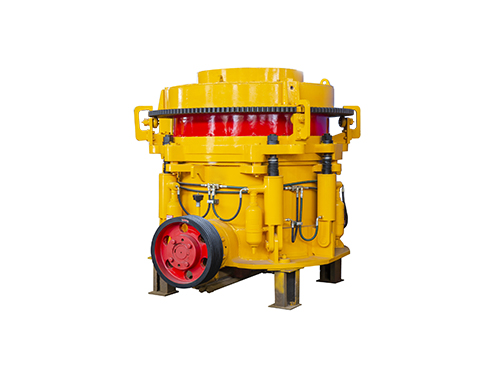 HPT Series Multi-cylinder Hydraulic Cone CrusherA multi-cylinder hydraulic cone crusher series with all-hydraulic operation, offering models from 13 to 33 tonnes for hard stone crushing and aggregate production.View Product →
1650 mm to 1800 mm: two-lift territory
At 38 to 55 tonnes the machine no longer ships as one liftable unit in a standard container. The frame alone may exceed 20 tonnes. Installation is normally planned as two or three separate lifts, and the foundation drawing must show the temporary support positions where the frame rests before grouting.
2100 mm to 2200 mm: break bulk and specialist rigging
At 75 to 90 tonnes these machines move on flat racks, in break bulk or on multi-axle low-bed trailers. Port handling needs a crane rated well above 100 tonnes, and the destination site needs a paved route and a pad strong enough for the crane outriggers. Budget for the rigging study before you sign the purchase order, not after.
Cavity choice barely changes the machine weight. Switching from a coarse to a fine cavity typically alters total weight by 1 to 3 percent, because it changes the mantle and bowl liner thickness, not the frame.
How Much Does a Mantle Weigh on Its Own?
Manganese steel runs at 7.7 to 7.9 tonnes per cubic metre. High-chrome liners sit slightly lower at 7.6 to 7.8. Once you know that density and the liner thickness, the weight becomes predictable: a 1200 mm mantle with a 60 mm average section and roughly 0.1 cubic metres of steel works out near 780 kg.
- A 900 mm mantle is typically 350 to 600 kg as a single casting.
- A 1200 mm mantle is typically 600 to 1,000 kg, or split into two pieces on larger castings.
- A 1650 mm mantle is typically 1.8 to 2.6 tonnes and is almost always a two-piece design.
- A 2200 mm mantle is typically 3 to 4.8 tonnes, handled as two or three separate castings.
The bowl liner set is a separate number and usually close to the mantle weight. On a 1200 mm machine the bowl is normally three or four segments of 150 to 300 kg each, which is deliberate: segments are light enough to move with a small crane and a sling, while a one-piece bowl of the same total weight would need much heavier lifting gear inside a confined space.
Worn liners weigh less, and that matters more than people expect
Manganese work-hardens and wears from the inside out. A liner is normally replaced when 15 to 25 percent of its original thickness remains, which means 75 to 85 percent of the original steel has been consumed. A 900 kg mantle at end of life may weigh only 250 to 400 kg. Two practical consequences follow. First, the scrap value you recover is calculated on the worn weight, not the original. Second, a used liner that has been sitting on a pallet for a year can be far lighter than the specification sheet suggests, so never quote a lifting plan from the original figure.
What Makes One Cone Crusher Heavier Than Another
Two machines with the same cone diameter and the same throughput target can differ by 8 tonnes. The reasons are structural, and each one shows up somewhere in the price.
Frame construction
A cast steel frame is typically 5 to 12 percent heavier than a fabricated plate frame of the same envelope, but it resists fatigue cracking far better under cyclic load.
Shaft arrangement
A top-supported fixed shaft carries a heavier spider and top bearing housing. A floating shaft removes that mass but shifts load into the frame and eccentric.
Hydraulic system
Single-cylinder designs add one large cylinder and one power unit. Multi-cylinder designs add four to eight cylinders, accumulators, manifolds and a bigger power unit, often 0.5 to 2 tonnes in total.
Liner thickness and grade
Moving from a 40 mm to a 70 mm section adds 10 to 20 percent to liner weight and proportionally more wear life, but also adds load on the head and the drive.
Eccentric throw and cavity
A longer throw means a heavier eccentric assembly and a larger drive train. It raises throughput per pass and also raises the dynamic load on the foundation.
Drive package
Motor, pulley, V-belts and guard range from 0.6 tonnes on a small unit to 3.5 tonnes on a 315 kW machine. Some quotations quietly exclude the motor.
Lubrication and cooling
Oil tank, pump, filter, cooler and piping add 0.3 to 1.5 tonnes. In hot climates the cooler can be the largest single accessory.
Base, mounts and access
Steel base frame, rubber mounts, walkways, handrails and guards are easy to overlook. Together they often add 4 to 8 percent of machine weight.
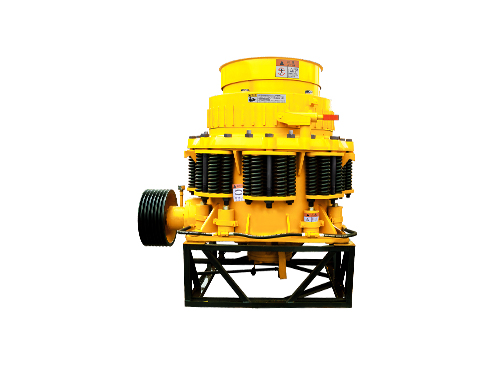 SMC Series Compound Cone CrusherA compound cone crusher for secondary and tertiary crushing, with models weighing 10.51 to 44.3 tonnes, featuring hydraulic adjustment and spring overload protection.View Product →
The practical planning point is simple: when you compare two quotations, compare the itemised sub-assembly weights, not the headline tonnage. A machine that is 2 tonnes lighter because the base frame was left off is not a lighter machine. It is a shorter scope of supply.
Weight Distribution Inside a Cone Crusher
Knowing the total weight is only half the job. Rigging crews and foundation designers need to know where that weight sits, because each major sub-assembly is lifted, set and shimmed separately.
| Sub-assembly | Share of machine weight | Practical implication |
|---|---|---|
| Main frame | 40 - 50 percent | Usually the heaviest single lift; sets the minimum crane class and the grouting sequence. |
| Adjustment ring and bowl assembly | 12 - 18 percent | Removed first during a full rebuild; needs a clear overhead path. |
| Crushing cone (head, shaft, mantle) | 8 - 14 percent | Lifted with the head nut still engaged; protects the shaft threads. |
| Eccentric and countershaft assemblies | 10 - 16 percent | Precision fits; never used as a lifting point and never dropped into place. |
| Drive, motor, pulley and guard | 5 - 9 percent | Frequently shipped loose and installed on site, which changes the shipping weight. |
| Hydraulic and lubrication packages | 3 - 6 percent | Skid-mounted and separate; needs its own pad and cable route. |
| Base frame, mounts, walkways, guards | 4 - 8 percent | Commonly excluded from quoted weights, so verify the scope. |
For a 25 tonne 1200 mm machine, that translates into a heaviest lift of roughly 11 to 13 tonnes for the frame, a cone assembly lift of 2 to 3.5 tonnes, and an eccentric lift of 1.5 to 2.5 tonnes. Those three figures are what you send to the crane company. The 25 tonne total is not.
Tonnes per Hour per Tonne of Machine: A Useful Selection Benchmark
Weight is not a cost on its own, but weight without output is. Divide rated throughput by installed machine weight and you get a ratio that shows how efficiently the steel is being used. Higher is generally better for capital efficiency, provided the machine is not being pushed beyond its recommended power draw.
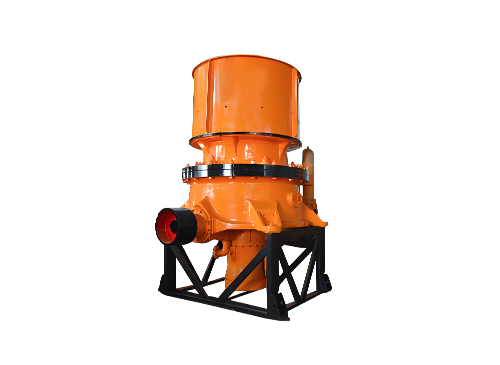 CS and CH Series Single-cylinder Cone CrusherA single-cylinder cone crusher with CS and CH series, offering motor power from 75-90 kW to 315 kW for aggregate, mining, and construction waste applications.View Product →
The pattern is not an argument for buying the largest machine available. It is an argument for matching the machine to the duty. A 2200 mm crusher running at 30 percent of capacity carries 90 tonnes of steel for very little output, and the fixed costs of that steel - foundation, crane, freight, spare liner inventory - are paid whether the machine runs or not.
A more practical caution: if a supplier claims throughput that pushes the ratio above roughly 10 tonnes per hour per tonne of machine weight on hard rock, check the closed side setting, the power draw and the feed gradation behind the number. Cone crushers cannot exceed the power they are given, and the motor rating is the hard ceiling.
Weight and Freight: Containers, Flat Racks and Break Bulk
Weight determines what you can ship, but dimensions determine how. Both matter, and they are often confused in early-stage planning.
- A 20 foot general purpose container carries roughly 25 to 28 tonnes of payload in theory, but many road leg limits cut that to 21 to 25 tonnes in practice.
- A 40 foot container carries 26 to 28 tonnes of payload regardless of the extra volume, because the limit is the road axle load, not the box.
- A 20 foot flat rack handles about 30 tonnes; a 40 foot flat rack about 40 tonnes.
- Above roughly 45 tonnes of single-piece weight, most routes move to break bulk or project cargo.
Dimension is the second filter. A 1200 mm cone crusher at 25 tonnes net plus a 1.2 tonne skid is about 26.2 tonnes gross, which is within a 40 foot container payload. But many frames in that band measure 2.4 to 2.9 metres across the base, and the container door opening is only about 2.34 metres wide and 2.28 metres high. Machines in this class therefore ship on flat racks or as break bulk even when the weight would fit inside a box.
Gross weight, packing weight and the third number nobody mentions
Outside the crate, there is the unloading weight at destination. If the site has no crane and the machine must be skidded off a trailer, the skidding load is the full gross weight plus friction, and it needs a prepared hardstand. Ordering a 120 tonne crane to a site with a gravel access road is a common and expensive mistake. Confirm the road, the pad and the crane radius before the vessel sails, not when the truck arrives.
Foundations, Dynamic Loads and the Crane You Will Actually Hire
A static weight of 25 tonnes does not mean the foundation carries 25 tonnes. Cone crushers impose a dynamic load on every rotation, and the foundation must be designed for the static mass plus a dynamic allowance. For cone crushers the dynamic factor commonly used in design is between 1.5 and 2.0, lower than for vibrating screens but still significant over a 15 to 20 year service life.
Three rules of thumb help when you are reviewing a foundation drawing:
- Concrete mass is often specified at two to three times the machine weight for the base block, which gives a 25 tonne crusher a block in the region of 50 to 75 tonnes.
- Anchor bolts are sized from the dynamic load, not the static weight, and are usually M24 to M42 depending on machine class.
- The mounting plane must be flat within a tight tolerance, typically 1 mm per metre, or the frame will distort and the eccentric will wear unevenly.
Crane selection in practice
Size the crane on the heaviest single lift at the working radius, then add 25 to 50 percent margin for boom length, load chart derating and a safety factor. A 13 tonne main frame lifted at 8 metres radius may need a 30 to 40 tonne crane rather than the 16 tonne unit a naive reading of the weight would suggest. Also confirm two things before the crane arrives: the position of the lifting lugs on the frame, and the headroom above the feed opening. A mantle change on a 1200 mm machine needs 2 to 4 metres of clear vertical space above the bowl, and that space is often occupied by the feed conveyor.
What Machine Weight Means at Wear-Part Changeout
Liner weight drives maintenance logistics more than any other number in this article. A 900 kg mantle cannot be handled by hand, but it can be managed with a 3 tonne shop crane, two fitters and a single shift. A 2.5 tonne mantle on a 1650 mm machine needs a 10 to 16 tonne mobile crane, a rigging plan, and often a scheduled shutdown rather than an opportunistic change.
Typical numbers for a 1200 mm machine in hard abrasive rock:
- Mantle and bowl liner change: 12 to 24 man-hours with a small mobile crane.
- Backing material consumption: 30 to 80 kg of zinc or epoxy compound per change.
- Liner life: 900 to 1,500 operating hours in hard abrasive rock, 2,000 to 3,000 hours in limestone.
- Wear cost: with a liner set priced at 4,000 to 9,000 US dollars and 100,000 tonnes crushed between changes, the wear cost is roughly 0.04 to 0.09 US dollars per tonne.
Keeping a matched set of cone crusher spare parts on site reduces the risk of a changeout being delayed by a wrong casting. Liner profiles change between cavity types, and a bowl liner from a coarse cavity will not seat correctly in a fine-cavity bowl. Confirm the cavity code stamped on the machine before you order.
Net Weight, Gross Weight and How to Verify a Quoted Figure
Weight figures in a quotation are self-declared until somebody weighs the machine. There are four practical checks, and doing all four takes less time than a single freight re-quote.
- Ask for the general arrangement drawing. It shows the total weight and the weight of each liftable component. A supplier who cannot produce a GA drawing with weights is not ready for an export order.
- Compare the quoted weight against the class norm. If a 1650 mm machine is quoted at 30 tonnes when the category sits at 38 to 52 tonnes, ask what was excluded.
- Request the packing list before shipment. It splits net, gross and shipping dimensions per package, which is what the forwarder actually needs.
- Ask for a weighbridge ticket for the loaded trailer. It is a single sheet of paper and it settles every subsequent dispute about freight cost, crane class and container loading.
A reasonable manufacturing tolerance on a cast and fabricated assembly is plus or minus 2 percent against the drawing. Anything larger usually means a design change not reflected in the documentation, or a different scope of supply. Both are worth resolving before the machine leaves the factory, and both are much easier to resolve with a factory visit than with email. Buyers who inspect the frame, the liner grade and the hydraulic package in person tend to have far fewer weight surprises at the port.
Motor Power, Energy Cost and the Weight-per-kW Ratio
Cone crushers in normal duty draw roughly 3.5 to 5.5 kW per tonne of machine weight. Below 3 kW per tonne the machine is oversized for a light duty and will never reach its rated output. Above 6 kW per tonne the drive is being pushed hard, and the eccentric, liners and lubrication system all wear faster.
The energy cost is where a weight decision becomes a financial one. Take a 1200 mm machine with a 160 kW motor running 6,000 hours a year at an 80 percent load factor and 0.12 US dollars per kilowatt hour:
- Absorbed power: 160 kW x 0.80 = 128 kW.
- Annual consumption: 128 kW x 6,000 hours = 768,000 kWh.
- Annual energy cost: 768,000 kWh x 0.12 = 92,160 US dollars.
Over five years that is roughly 460,000 US dollars, against a machine purchase price that may be a fraction of it. This is why the sensible comparison is not "which machine weighs less", but "which machine produces the required tonnage at the lowest energy and wear cost per tonne". A heavier frame that holds alignment and keeps the closed side setting stable often pays back through liner life and reduced downtime, even though it costs more to freight and more to lift.
Cone Crusher Weight Inside a Complete Crushing Plant
Most buyers are not purchasing a single machine. They are building a line, and the total equipment weight drives the civil works, the access roads and the erection schedule. These are typical equipment totals, excluding structures and foundations:
- A 100 tonne per hour line: 60 to 90 tonnes of equipment, of which the cone crusher is 20 to 27 tonnes.
- A 200 tonne per hour line: 100 to 150 tonnes, with one or two cone crushers in the 25 to 55 tonne range.
- A 300 tonne per hour line: 160 to 230 tonnes, typically with a primary jaw, two cone stages, screens, feeders and 15 to 25 conveyors.
Conveyors are the underestimated item. A single 800 mm belt conveyor 30 metres long weighs 4 to 8 tonnes with its frame, and a full line can carry 15 to 25 of them. That is 60 to 150 tonnes of steel that never appears in a crusher specification sheet but absolutely appears in the steel erection contract.
Mobile and wheel-mounted plants compress these numbers dramatically. A track-mounted cone plant with an integrated screen and return conveyor typically weighs 32 to 55 tonnes in working order, including the tracks and the onboard diesel or electric drive. A wheel-mounted cone plant usually sits at 25 to 45 tonnes. Both need transport permits in most countries, and the tracked unit needs a low-bed trailer rated above its operating weight, not its stripped weight.
Eight Weight-Related Risks in a Cone Crusher Quotation
These are the recurring issues that cost money after the contract is signed. Each one is avoidable with a single question.
- Quoted weight excludes the motor, base frame, guards and lubrication station, adding 2 to 6 tonnes at the port.
- Gross weight is quoted as net weight, so the freight quote is built on a number that does not exist.
- Liner grade is unspecified, and a thinner Mn13 casting replaces a specified Mn18 casting at the same headline price.
- Crane class is chosen from total machine weight rather than the heaviest single lift, which is 40 to 50 percent of it.
- Foundation is designed for static load only, with no dynamic allowance, leading to cracking within two or three years.
- Headroom for a mantle change is not checked against the feed conveyor, turning a one-shift job into a two-day job.
- Road axle limits at the destination are not verified, so a legal load becomes an overload permit or a re-route.
- Spare liner profile is not matched to the cavity code, so the second liner set does not seat properly.
A supplier that publishes sub-assembly weights, provides a GA drawing with lifting points, and confirms the packing list before shipment removes most of this risk from the table. When a factory also states a stable delivery lead time, the weight conversation stops being a negotiation and becomes a planning input.
FAQ: Cone Crusher Weight Questions
How heavy is a crusher cone?
The complete machine ranges from about 5.5 tonnes for a 600 mm unit to 90 tonnes for a 2200 mm unit. The crushing cone assembly itself, meaning the head, shaft and mantle, is roughly 8 to 14 percent of that total: 600 to 1,000 kg on a 1200 mm machine and 3 to 4.8 tonnes on a 2200 mm machine.
How much does a cone crusher mantle weigh?
A single mantle casting is typically 350 to 600 kg at 900 mm, 600 to 1,000 kg at 1200 mm, 1.8 to 2.6 tonnes at 1650 mm and 3 to 4.8 tonnes at 2200 mm. Large mantles are often supplied in two or three pieces so they can be handled with standard lifting gear.
Is a heavier cone crusher always better?
No. Weight buys frame stiffness, stability and often longer liner life, but it also buys freight cost, foundation cost, crane cost and spare liner inventory. The useful comparison is tonnes per hour per tonne of machine weight combined with wear cost per tonne of product.
Can a cone crusher fit in a 20 foot container?
Machines up to about 13 tonnes usually can. A 1200 mm machine at 22 to 27 tonnes will exceed the practical payload once the skid and loose items are added, and its frame base is often wider than the 2.34 metre door opening. Plan on a 40 foot container, a flat rack or break bulk for that class.
How much does a 1200 mm cone crusher weigh?
Between 22 and 30 tonnes for the complete machine with motor, base and hydraulic package. A spring-type machine in this class is commonly listed near 24 to 25 tonnes, while a lighter single-cylinder frame can come in at 15 to 20 tonnes for comparable duty. Always confirm the scope behind the figure.
What crane capacity do I need to install a cone crusher?
Match the crane to the heaviest single lift, which is normally the main frame at 40 to 50 percent of the total machine weight, then add 25 to 50 percent margin for radius and boom derating. A 25 tonne machine usually needs a 25 to 40 tonne crane depending on the working radius and access.
Does the cavity type change the machine weight?
Only slightly. Moving from a coarse to a fine cavity changes the mantle and bowl liner thickness and typically shifts total machine weight by 1 to 3 percent. The frame, eccentric and drive remain unchanged.
How do I verify the weight I have been quoted?
Ask for the general arrangement drawing with component weights, the packing list with net and gross figures per package, and a weighbridge ticket for the loaded trailer. A tolerance of plus or minus 2 percent against the drawing is normal for cast and fabricated assemblies.