English
 русский
Put a jaw crusher and a cone crusher on the same granite deposit and both will break rock. Put them in the same slot of a flowsheet and one of them will fail the job. That is the practical answer behind the question "which is better, a cone crusher or a jaw crusher" — the comparison only becomes meaningful once you know which stage of the circuit you are buying for.
In a normal aggregate or mining plant the two machines are not rivals at all. A jaw crusher takes run-of-mine rock at 500 to 1,000 mm and reduces it to roughly 100 to 200 mm. A cone crusher takes that 100 to 200 mm product and reduces it to 40 mm, 20 mm, or 0 to 10 mm manufactured sand. Buying one where the other belongs is the single most expensive mistake we see in plant design, because the wrong machine does not simply perform worse — it destroys the economics of every stage behind it.
This article covers the mechanism of each machine, the feed conditions each one tolerates, the real drivers of cost per ton, and the questions you should answer before signing a purchase order.
Content
- 1 The Short Answer: Stage Matters More Than the Machine
- 2 Jaw Crusher vs Cone Crusher: Side-by-Side Comparison
- 3 How a Jaw Crusher Breaks Rock
- 4 How a Cone Crusher Breaks Rock
- 5 Where Each Machine Belongs in the Crushing Circuit
- 6 Feed Size Rules: What a Jaw Accepts and What a Cone Rejects
- 7 Hardness, Abrasiveness and the Cost of Getting It Wrong
- 8 Capacity, Closed Side Setting and the Production Curve
- 9 Product Shape and Gradation
- 10 Capital Cost, Energy and Wear: Reading Cost Per Ton
- 11 Moisture, Clay and Sticky Feed
- 12 Maintenance, Availability and Spare Parts Strategy
- 13 Fixed, Crawler or Tire-Mounted: Does Mobility Change the Answer?
- 14 A Five-Step Decision Path
- 15 What to Send for an Accurate Crusher Recommendation
- 16 Common Procurement Mistakes That Cost More Than the Crusher
- 17 Frequently Asked Questions
- 17.1 Can a jaw crusher replace a cone crusher for secondary crushing?
- 17.2 Can a cone crusher be used as a primary crusher?
- 17.3 Which machine has the lower operating cost?
- 17.4 What is the maximum feed size for a cone crusher?
- 17.5 Why does my cone crusher produce too many fines and a poor shape?
- 17.6 Do I need both machines, or can one do the whole job?
- 17.7 How long does it take to change cone crusher liners?
The Short Answer: Stage Matters More Than the Machine
For hard, abrasive rock, the jaw crusher is the correct choice for the first stage and the cone crusher is the correct choice for every stage after it. That single sentence resolves the majority of real selection decisions. The exceptions are narrow and easy to test: soft or medium-hard material with a small feed, very low tonnage, or a requirement for a highly cubical product, all of which can shift the answer.
Buy a jaw crusher when
- Top feed size is above 300 mm and can reach 1,000 mm or more.
- Material is hard, blocky, or arrives wet and sticky with clay.
- You need a primary stage that runs with minimum supervision.
- Your downstream cone or impactor needs a consistent 100 to 200 mm feed.
- Budget per unit of installed capacity is a priority at the coarse end.
Buy a cone crusher when
- Target product is 40 mm, 20 mm, or finer, including manufactured sand.
- Feed is already reduced to below roughly 300 mm and can be screened.
- Material is medium-hard to very hard, such as granite, basalt, or quartzite.
- You need high tonnage per installed kilowatt at fine settings.
- Your plant can supply a steady, choke-fed, dry feed stream.
The one-machine case: if your feed is already below about 300 mm and your target is 20 mm or finer, skip the jaw entirely and buy a cone. If your feed is 800 mm and your target is 150 mm for a road base contract, a jaw alone may be enough and a cone would be wasted capital.
Jaw Crusher vs Cone Crusher: Side-by-Side Comparison
The table below is the fastest way to see where the two machines diverge. Read it as a screening tool rather than a specification sheet, because capacity and product size always depend on the specific model and chamber you install.
| Factor | Jaw crusher | Cone crusher |
|---|---|---|
| Typical circuit stage | Primary, occasionally secondary in small plants | Secondary, tertiary or quaternary |
| Breaking mechanism | Compression between a fixed jaw plate and a swinging jaw plate | Compression by a gyrating mantle inside a stationary bowl liner |
| Working reduction ratio | About 4:1, up to 6:1 in favourable rock | About 3:1 to 4:1 per machine |
| Typical maximum feed | 500 mm to over 1,000 mm depending on model | 200 to 300 mm with a standard chamber, 80 to 150 mm with a short head |
| Typical product P80 | 100 to 200 mm | 20 to 50 mm secondary, 10 to 25 mm or finer tertiary |
| Feed condition tolerance | Handles wet, sticky and clay-rich feed | Requires dry, clean, choke-fed material |
| Particle shape | Flatter, more slabby particles | More cubical, especially at a low reduction ratio |
| Capacity per installed kilowatt at fine sizes | Low | High |
| Relative capital cost at equal tonnage | Lower | Higher |
| Main wear parts | Fixed and moving jaw plates, toggle plate, cheek plates | Mantle, bowl liner, socket liner |
| Setting adjustment | Shims, wedges or hydraulic | Hydraulic cylinders or spring release |
| Overload protection | Toggle plate bends or breaks as a sacrificial part | Hydraulic relief, spring release, tramp iron passage |
| Failure mode when misapplied | Product too coarse for the next stage, high circulating load | Chamber packing, uneven liner wear, damaged main shaft |
| Best application | First stage of any hard-rock plant | Fine reduction and manufactured sand |
How a Jaw Crusher Breaks Rock
The mechanism
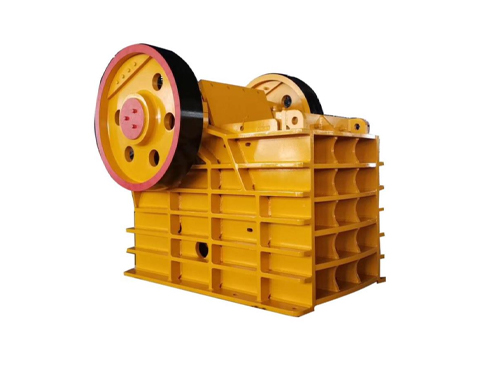
A jaw crusher is a compression machine. A hardened fixed jaw plate sits on one side of the chamber, and a moving jaw plate swings toward it on an eccentric shaft driven by V-belts and a flywheel. Rock is squeezed, and when the moving jaw retreats, the broken material drops toward the discharge opening. The toggle plate does two jobs: it transfers force and it acts as the sacrificial component that fails first under an overload, protecting the shaft and bearings.
What actually sets capacity
Four variables dominate throughput: the closed side setting, the eccentric stroke, the rotational speed, and the feed gradation. A jaw crusher fed with a properly graded blend runs far more efficiently than one fed with a single coarse lump size, because the fines fill the voids and let the coarse particles fracture against each other. In our experience, poor feeder control can cut a jaw's output by 20 to 40 percent without any mechanical fault at all. Feed material should be presented across the full width of the chamber, never dumped in a single pile at one end.
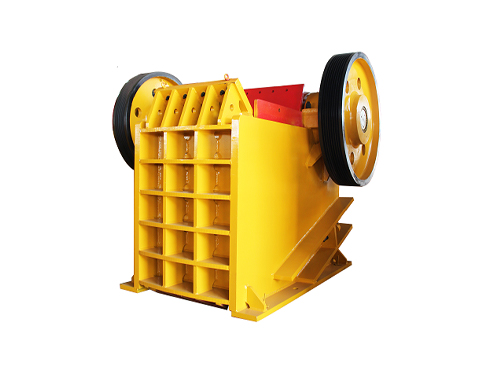
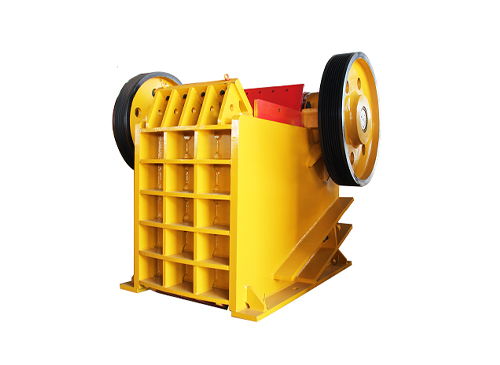 PE Jaw CrusherPE series jaw crusher meets the national standards in terms of its specifications and parameters. The jaw Crushers are generally applied for primary crushing and broad...View Product →
Where the limits are
The most common sizing error is feeding rock larger than the chamber can accept. As a working rule, the largest lump should be no more than 80 to 85 percent of the feed opening width, and slabby or elongated rock should be kept even smaller because it bridges easily. Jaw crushers also produce a relatively flaky product, so a plant that tries to make a 20 mm specification aggregate with a jaw alone ends up with excess recirculating load and an overworked screen.
How a Cone Crusher Breaks Rock
Laminating inside a choke-fed chamber
A cone crusher replaces the flat jaw geometry with a conical mantle that gyrates inside a bowl liner. The eccentric rotation creates a continuously closing and opening gap around the chamber, so material is crushed many times as it descends. This laminating action is what produces a finer and better-shaped product than a jaw at the same reduction ratio.
The critical operating condition is choke feeding. The chamber must be kept full so that inter-particle crushing does most of the work. A cone crusher that is starved of feed will not reach its rated capacity, will produce a coarser and more elongated product, and will wear its liners unevenly. A surge bin above the crusher plus a variable-speed feeder and a level sensor is not optional equipment — it is part of the machine's performance specification.
Chamber types and what they change
The same crusher body can usually accept several liner profiles: coarse, medium, fine and extra fine, and in some ranges a standard head and a short head version. A coarse chamber accepts a larger feed but finishes coarser. A fine chamber accepts a smaller feed and produces a much finer product at a lower throughput. Choosing the chamber is therefore a production decision, not an accessory decision, and it should be made together with the screen cut points of the whole circuit.
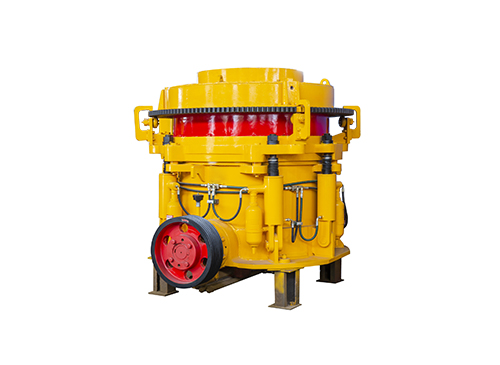
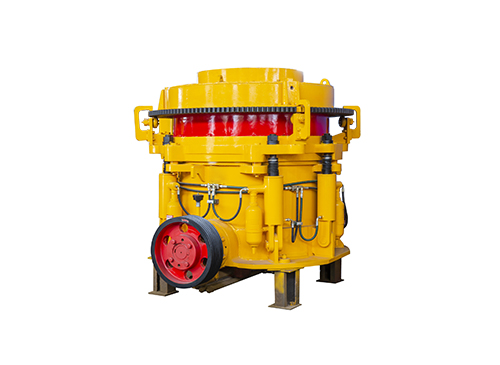 Multi-cylinder Hydraulic Cone CrusherAdvanced design; All hydraulic operation; High reduction efficiency low consumption; Robust and reliable design for hard stone; Easy operation and maintenance;View Product →
Hydraulic versus spring design
Spring and compound cone crushers release tramp iron by compressing a spring package, which limits the crushing force they can hold. Hydraulic designs, particularly the single-cylinder and multi-cylinder types, adjust the setting hydraulically, pass tramp metal through a relief cylinder and allow the chamber to be cleared quickly after a blockage. In abrasive, hard-rock duty the hydraulic types pay back their higher purchase price through reduced downtime and more stable product size.
Where Each Machine Belongs in the Crushing Circuit
Total reduction is the number that decides how many stages you need. Reducing 800 mm rock to a 20 mm product is a 40:1 job. Since a jaw achieves roughly 4:1 and a cone achieves roughly 3:1 to 4:1 per machine, three stages are required in almost every hard-rock flowsheet.
Stage 1 — Primary
Jaw crusher fed directly by dump truck or excavator, often through a vibrating grizzly feeder that scalps fines before the chamber. Output P80 typically 100 to 200 mm.
Stage 2 — Secondary
A standard-head or multi-cylinder cone crusher fed by screened primary product. Output P80 typically 20 to 50 mm, with a circulating load returning from the screen.
Stage 3 — Tertiary or sand
A short-head cone, a fine-chamber cone, or a vertical shaft impactor for cubicity and manufactured sand. Output 0 to 20 mm, 0 to 10 mm or finer.
Small plants sometimes run a jaw in the primary stage and sell the 0 to 40 mm product directly, which is a legitimate configuration when the material is soft and the market accepts the shape. Equally, a plant with a screen-equipped mobile jaw can feed a cone directly, but only if the screened fraction is genuinely within the cone's feed range.
Feed Size Rules: What a Jaw Accepts and What a Cone Rejects
The feed opening is a hard boundary, but the more useful number is the 80 percent passing size, usually written as P80. Design your circuit around the P80 of the material you will actually receive, not the best-case figure from a blasting report.
- Jaw crusher: maximum lump about 80 to 85 percent of the feed opening width. Design conservatively if the rock is slabby.
- Standard cone crusher: maximum feed about 200 to 300 mm, and it must be screened, not run-of-mine.
- Short-head or fine-chamber cone: maximum feed commonly 80 to 150 mm, sometimes less.
- Any cone crusher: material smaller than the closed side setting passes through untouched and contributes nothing but wear and noise.
- Any cone crusher: oversized lumps risk broken gears, bent shafts and bowl liner damage, and are never covered by warranty.
Hardness, Abrasiveness and the Cost of Getting It Wrong
Two rock properties drive every selection decision, and they are not the same property. Hardness, usually expressed as a Bond work index or in kilowatt hours per ton, determines how much energy the rock consumes. Abrasiveness, often expressed as a Bond abrasion index or estimated from silica content, determines how fast your wear parts disappear.
Limestone typically sits in the region of 10 to 12 kilowatt hours per ton with low abrasiveness. Granite generally falls between 14 and 16. Quartzite and some iron ores run noticeably higher, and their silica content makes them aggressive on manganese. A jaw crusher handles all of these in the primary stage without much complaint, because the crushing force is applied slowly. A cone crusher also handles them, but liner consumption on a very abrasive ore can be two to three times higher than on limestone, and that difference decides whether the project makes money.
The consequence is simple. Hard, abrasive rock reinforces the case for a jaw in the primary stage and a robust hydraulic cone in the secondary stage, with a realistic liner budget. Softer rock opens the door to alternative flowsheets and, in some cases, to a single-stage solution.
Capacity, Closed Side Setting and the Production Curve
Capacity is never a single number. For a jaw crusher it is a function of the closed side setting, and for a cone crusher it depends on the closed side setting, the eccentric throw, the chamber profile and the feed bulk density. Two plants running identical machines can differ wildly simply because one measures capacity at a 40 mm setting and the other quotes a 25 mm setting.
Indicative reduction ratio by stage — plan the circuit around these figures
Closing a cone's setting reduces throughput while increasing the proportion of fines. The left-hand column is the hardest product to make and the one that most often justifies a tertiary stage.
The screen, not the crusher, is usually the real bottleneck. A tertiary cone in closed circuit typically carries a circulating load of 100 to 300 percent, which means the screen and the conveyors must be sized for two to four times the finished tonnage. Under-sizing the screen is a classic error: the crusher is blamed for poor output when the deck simply cannot pass the material fast enough.
Product Shape and Gradation
Particle shape matters most in concrete and asphalt aggregate, where flaky and elongated particles reduce workability and increase binder demand. A jaw crusher at a high reduction ratio produces the flattest product of the common machines, which is why a jaw is rarely used to make a 20 mm specification stone. A cone crusher produces noticeably better shape because of its laminating action, and shape improves further when the reduction ratio per stage is kept modest and the crusher runs in closed circuit.
If strict cubicity is the governing requirement, the usual answer is a vertical shaft impactor for the final stage, fed with a controlled 10 to 20 mm fraction. That raises operating cost, so it is normally reserved for the sand and premium aggregate fractions rather than the whole product range.
Gradation is a separate question from shape. If your target curve requires a specific passing percentage at several sieves, the circuit must be designed backward from that curve: first choose the screen cut points, then choose the crusher chamber that produces a feed suitable for those screens.
Capital Cost, Energy and Wear: Reading Cost Per Ton
A cone crusher costs more than a jaw crusher of similar throughput, and it also draws more power per ton of finished product. That comparison is misleading, however, because the two machines produce different products. The correct comparison is cost per ton of saleable material, and at fine sizes the cone wins by a wide margin simply because a jaw cannot make the product at all.
Indicative split of crushing plant operating cost
The share of each item shifts with rock type. On abrasive quartzite, wear parts can overtake energy as the largest single line.
When you evaluate quotes, ask for wear cost per ton rather than liner price. A cheaper mantle that lasts 40 percent fewer hours is the more expensive part. Ask also for the expected liner life in hours at a stated closed side setting and a stated rock type, and for the manganese grade used. This is the only way to compare two suppliers honestly, and it also protects you during the operating budget review in year two.
Moisture, Clay and Sticky Feed
Jaw crushers tolerate wet and sticky material far better than cone crushers, simply because the chamber is open at the bottom and the material is pushed through by a single mechanical stroke. Clay-rich feed can still cause build-up on the jaw plates and bridging in the hopper, but the machine keeps running.
A cone crusher is far less forgiving. When the feed is damp, the fines pack into the chamber, the crushing force rises, and the crusher can begin to "pump" or ride up on its springs or relief cylinders. The consequences are reduced throughput, a coarser and inconsistent product, accelerated liner wear concentrated in one zone, and eventually a blockage that stops the plant. In wet climates or in the rainy season, a covered stockpile, a pre-screen to remove fines, and a heated or insulated lubrication system are sensible investments rather than luxuries.
High-altitude sites add a second consideration: motors and hydraulic power units lose effective capacity as air density falls, so the installed power must be reviewed rather than copied from a sea-level reference plant.
Maintenance, Availability and Spare Parts Strategy
Neither machine is maintenance-free, but the maintenance profiles differ. A jaw crusher is mechanically simple. Its routine work is greasing or oil circulation, checking the toggle plate and seats, monitoring cheek plates, and rotating or replacing jaw plates. A cone crusher adds a hydraulic system, a lubrication circuit with oil temperature and cleanliness requirements, and a set of precision fits that must be respected.
- Jaw crusher consumables: fixed jaw plate, moving jaw plate, cheek plates, toggle plate and seats, bearings and seals.
- Cone crusher consumables: mantle, bowl liner, socket liner, eccentric wearing plates, dust seal ring, hydraulic filters and oil.
- Both machines: drive belts, motor bearings, feeder liners and the surge bin arrangement.
Availability is won or lost on stocking decisions. Holding a spare set of liners and a toggle plate on site can turn a two-week production stoppage into a four-hour liner change. For cone crushers, a matched set of cone crusher spare and wear parts kept alongside a documented change-out procedure is one of the highest-return investments in the plant.
Also plan the lifting and access. Liner changes are heavy, confined work, and a crusher installed without adequate crane access or a proper platform will take significantly longer to service than its design allows.
Fixed, Crawler or Tire-Mounted: Does Mobility Change the Answer?
It does not change the physics, but it changes the practical split. A crawler-mounted jaw plant is the standard solution for contract crushing and for quarries that move the primary stage with the working face. The jaw is well suited to a mobile chassis because it is robust, tolerant of variable feed, and easy to feed directly from an excavator.
Mobile cone plants are usually the second unit in a train: the crawler jaw discharges onto a screen, and the screened oversize feeds the cone, with recirculation back to the screen. For demolition and construction waste, a transportable plant with a jaw and a screen often produces a specification recycled aggregate without any cone at all.
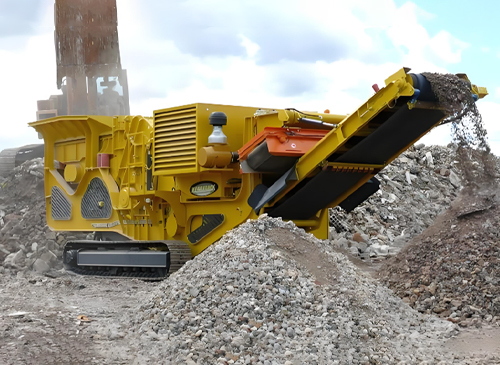 Crawler Mobile Crusher PlantCrawler mobile crusher plants are easily movable at and between production sites. It integrates material-accepting, crushing, and transporting into one. It has advance...View Product →
For permanent quarries producing high tonnage, stationary units remain more economical per ton because they allow larger chambers, larger motors and better surge capacity. The mobile-versus-fixed decision should be made after the crushing stages are defined, not before.
A Five-Step Decision Path
- Define the feed: maximum lump size, P80, bulk density, moisture content, clay content and whether the material is screened or run-of-mine.
- Define the product: target sieve curve, required cubicity, and the percentage of each commercial fraction you intend to sell.
- Calculate the reduction stages: multiply expected reduction ratios and confirm that the number of stages fits your flowsheet and your budget.
- Test the rock: a work index and an abrasion value turn a guess into an engineering decision, especially for hard or abrasive deposits.
- Size the balance of plant: screens, feeders, surge bins, conveyors, dust control and the stockpile layout. Under-sizing these items is what makes a good crusher look like a bad one.
What to Send for an Accurate Crusher Recommendation
A supplier can only size a machine correctly against real data. When you request a proposal, include the following, and expect a serious quotation to reference each point.
- Rock type, and if available a petrographic description or a test report.
- Maximum lump size and P80 of the feed, with a note on how the material is loaded.
- Bulk density and moisture content, plus whether the feed is blended or comes from a single face.
- Required tonnage in dry tonnes per hour, and the closed side setting it must be achieved at.
- Target product curve, not just a single nominal size.
- Site conditions: altitude, ambient temperature range, power supply voltage and frequency, and available space.
- Operating pattern: shifts per day, days per year, and whether the plant will be operated by your team or a contractor.
- Spare parts expectations, including whether you intend to hold liners and toggles on site.
Shanghai Sanming Mining Equipment Manufacturing Co., Ltd. has been building crushing and screening equipment since 2012, with manufacturing based at Qidong in the Shanghai Pudong industrial area and an ISO9001 quality management system behind production. We welcome plant visits, and we routinely build customised solutions where a standard model does not quite fit the feed or the product curve. If you want to see how we work, the company profile and factory information is a reasonable starting point. Our average delivery time is around 20 days, and a significant share of our equipment is exported to Central Asia, the Middle East, South America and Africa, so we are used to supporting plants in demanding conditions.
Common Procurement Mistakes That Cost More Than the Crusher
Most disappointing installations are traceable to one of the following, and none of them are the crusher's fault.
- Buying on capital price alone, without asking for wear cost per ton at a stated setting.
- Comparing capacity figures quoted at different closed side settings, which makes the cheaper machine look better on paper.
- Buying a cone for primary duty because the quarry wants to save one stage.
- Under-sizing the screen, the feeder or the surge bin, then blaming the crusher for low output.
- Ignoring moisture and clay until the first rainy season, when the cone begins to pack.
- Choosing a chamber profile by habit rather than by the target product curve.
- Failing to plan crane access, and discovering at the first liner change that the job takes three days instead of one.
- Not stocking critical spares, then paying airfreight and lost production for a part that costs little.
Each of these is avoidable with a short technical review before the order is placed. That review is far cheaper than a redesign after commissioning.
Frequently Asked Questions
Can a jaw crusher replace a cone crusher for secondary crushing?
In soft material and at low tonnage, yes. In hard rock and at fine settings, no. A jaw crusher cannot economically produce a 20 mm product, and the flaky shape it generates usually fails aggregate specifications. The energy and wear cost per ton of finished material rises sharply as the target size falls.
Can a cone crusher be used as a primary crusher?
Only if the feed is already reduced and screened to suit the chamber, which is common in some mining flowsheets where a jaw is replaced by a large gyratory or where the mine delivers pre-crushed ore. For a quarry feeding 600 mm run-of-mine rock directly, a cone in the primary position is the wrong choice and will lead to blockages, damage and premature wear.
Which machine has the lower operating cost?
It depends entirely on the product size. At coarse output the jaw is cheaper per ton. At fine output the cone is cheaper per ton, because a jaw attempting the same job would need multiple passes, more screening and more recirculation. Compare cost per ton of saleable product, never cost per machine hour.
What is the maximum feed size for a cone crusher?
Roughly 200 to 300 mm for a standard chamber and 80 to 150 mm for a short-head or fine chamber, with exact limits set by the model and liner profile. The feed must also be screened and free of oversized slabs, and it must be presented at a controlled rate to maintain choke feed.
Why does my cone crusher produce too many fines and a poor shape?
Usually because the reduction ratio per stage is too high, the chamber is starved rather than choke-fed, or the closed side setting is tighter than the circuit needs. Adjusting the screen cut points, restoring proper choke feed, or adding a separate tertiary stage often solves the problem at lower cost than changing the machine.
Do I need both machines, or can one do the whole job?
If your feed is under about 300 mm and your product is 40 mm or coarser, one cone can often do the entire job. If your feed is 800 mm and your product is 20 mm, you need at least two stages and normally three. The number of stages is determined by total reduction, not by preference.
How long does it take to change cone crusher liners?
With good access, the right lifting equipment and a stocked spare set, a mantle and bowl liner change is typically a single-shift job. Without adequate access or with the wrong tooling, it can stretch to several days, which is why plant layout and spares policy deserve attention before the machine is ordered.