English
 русский

Content
- 1 Mobile vs stationary crushing plants: where the money actually goes
- 2 Capital expenditure: what the invoice does not show
- 3 Operating cost per tonne: the advantage the brochure never prints
- 4 Flexibility is measured in months, not in machine design
- 5 Output and product shape: what changes when the plant moves
- 6 Wheel-mounted and modular plants: the middle ground that sometimes is not worth it
- 7 Five situations where a stationary plant still wins outright
- 8 From order to nameplate output: the timeline that surprises buyers
- 9 A five-year total cost model with real numbers
- 10 Purchase checklist before the deposit is signed off
- 11 Common buying errors in mobile versus stationary decisions
- 12 Frequently asked questions
- 12.1 Is a mobile crushing plant more expensive than a stationary one?
- 12.2 How long does it take to relocate a crushing plant?
- 12.3 Can a mobile plant match the product quality of a fixed plant?
- 12.4 Do mobile plants consume more energy per tonne?
- 12.5 What capacity can a wheel-mounted plant realistically reach?
- 12.6 Which configuration suits construction and demolition waste?
- 12.7 Can a modular plant be converted to a fully stationary one later?
- 12.8 What is the single most useful question to ask a supplier?
Mobile vs stationary crushing plants: where the money actually goes
For most quarries and recycling yards running between 150 t/h and 500 t/h, the short answer is blunt: if the same site will be worked for more than five years, a fixed plant is still the cheapest way to buy installed tonnes per hour; if the ground under the crusher changes every season, a wheel-mounted or crawler unit has usually paid back its premium by the second project.
That comparison only becomes useful when the word "mobile" is broken into the three very different machines it actually covers, because the gap between a stationary plant and a wheeled plant is far wider than the gap between a wheeled plant and a tracked one.
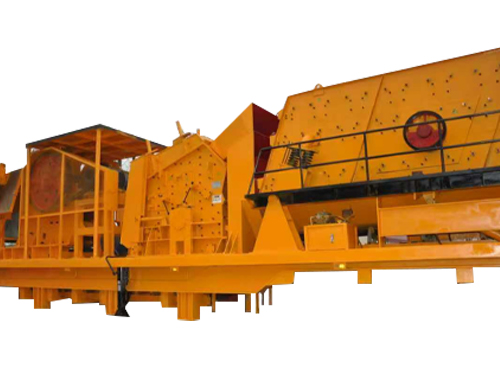
- Stationary — permanent steel platform on concrete foundations, hard-wired to the grid, 100–1000 t/h.
- Modular — bolted steel modules on shallow foundations or compacted hardstanding, 150–600 t/h.
- Wheel-mounted — trailer chassis with axles and outriggers, towed by a tractor unit, 80–300 t/h.
- Crawler — self-propelled hydraulic undercarriage, walks across the bench, 100–400 t/h.
Each configuration has a different capital profile, a different relocation cost and a different way of pulling power. Below is the side-by-side picture that most purchase decisions actually turn on.
| Configuration | Foundation and civil work | Typical capacity | Relocation time | Capital index | Power source |
|---|---|---|---|---|---|
| Stationary | Concrete foundations, 4–8 weeks | 200–1000 t/h | Not relocatable | 100 | Grid electricity |
| Modular | Shallow foundation or steel frame, 2–4 weeks | 150–600 t/h | 7–14 days | 112 | Grid electricity |
| Wheel-mounted | Compacted hardstanding plus outriggers, 3–7 days | 80–300 t/h | 2–3 days | 125 | Grid or generator set |
| Crawler | Compacted hardstanding, no crane required, 1–3 days | 100–400 t/h | Hours | 145 | On-board diesel or site supply |
The number worth memorising is the relocation interval. A stationary plant that never moves is unbeatable on every metric. A stationary plant that has to be rebuilt once a year stops being a low-cost option almost immediately, because civil works and erection labour are paid again in full while the crusher itself delivers exactly the same output.
Capital expenditure: what the invoice does not show
On a 250 t/h stationary two-stage line, the crushers, screens and conveyors typically account for 50%–60% of the project budget. Everything else is what buyers underestimate: civil works at 15%–25%, structural steel and walkways at 8%–12%, electrical and control at 6%–10%, and erection and commissioning at 5%–8%.
Move the same duty onto a wheeled chassis and the distribution flips. Equipment climbs to roughly 75%–85% of the budget, electrical drops to 5%–8%, installation falls to 2%–4%, and civil work becomes a levelled patch of compacted stone. That is why quotations for mobile and stationary plants can look closer than expected when only the machine price is compared — the fixed plant hides much of its cost in concrete.
Read the chart as cost per installed tonne per hour, not cost per machine. A crawler plant carries its own undercarriage, hydraulic circuit and on-board control, which is real engineering — but a buyer paying 45% more per tonne per hour needs that premium to be recovered by something other than convenience. In practice it is recovered by avoided civil works, avoided erection labour and avoided idle time between sites.
The steel tonnage question
A stationary plant for the same duty frequently weighs 60%–90% more than a mobile unit, because the chassis is replaced by structural steel and the conveyor runs are longer. That tonnage must be designed, fabricated, shipped, erected and maintained. For a buyer comparing two quotations, ask for the total installed weight and the erection hours — a lower machine price with heavier civil works and longer erection is often the more expensive route.
Operating cost per tonne: the advantage the brochure never prints
Stationary plants win the operating argument for one unglamorous reason: a fixed-speed electric motor fed from the grid converts roughly twice as much input energy into crushed rock as a diesel generator set feeding the same motor. On a medium-hard limestone duty, crushing power consumption usually lands between 1.2 and 2.0 kWh per tonne for a grid-connected plant, and between 2.0 and 3.2 kWh per tonne for a diesel-driven unit.
The gap widens further when fuel is priced. A tracked plant burning 0.9–1.6 litres of diesel per tonne is spending several times more on energy than the equivalent grid-fed plant, and that difference is paid every hour the machine runs — not once at purchase.
| Cost item | Stationary (grid) | Wheel-mounted | Crawler (diesel) |
|---|---|---|---|
| Energy per tonne | 1.2–2.0 kWh | 1.5–2.4 kWh | 0.9–1.6 litres of diesel |
| Operators per shift | 3–6 | 2–4 | 2–3 |
| Wear parts relative to stationary | Baseline | +5% to +10% | +10% to +20% |
| Building and structure upkeep | Required | None | None |
| Typical downtime for a site move | Weeks (rebuild) | 2–3 days | Under 1 day |
Labour is the one line where mobile plants genuinely save. A crawler spread running a hopper, a jaw and a screen needs two operators and one loader driver; the same duty on a fixed plant with three conveyors, a control room and a wash point often needs five or six. On a two-shift operation that difference is real money, and it partly offsets the fuel bill on sites where diesel is cheap and labour is expensive.
The practical conclusion: if a mobile plant can be plugged into site power rather than run on its own generator, the operating gap against a stationary line narrows to something recoverable within two to three years. If it must burn diesel for its whole working life, the gap never closes, and the purchase has to be justified purely by relocation and permitting savings.
Flexibility is measured in months, not in machine design
Buyers rarely ask the right flexibility question. The useful one is not "can this plant move?" but "what does one move cost me in money and in lost production?" Those are very different numbers, and the second one usually decides the purchase.
Rebuilding a stationary plant on a new site means new foundations, new steel, new cable runs, a new permit file and a commissioning period. Treat it as a new project, because that is what it is. Wheel-mounted equipment needs a low-loader, a crane for the heaviest module, and two to three days of hook-up and alignment. A crawler unit needs a flatbed for long hauls or simply drives to the next bench under its own power.
The permitting side matters just as much. A fixed installation with buildings, conveyors and a permanent power connection usually triggers a full environmental and construction approval cycle. Mobile equipment working the same deposit under an existing extraction consent can frequently be redeployed with far less paperwork — sometimes within a single approval envelope. For contractors bidding on road, rail and demolition work, that difference in lead time is worth more than the machine price gap.
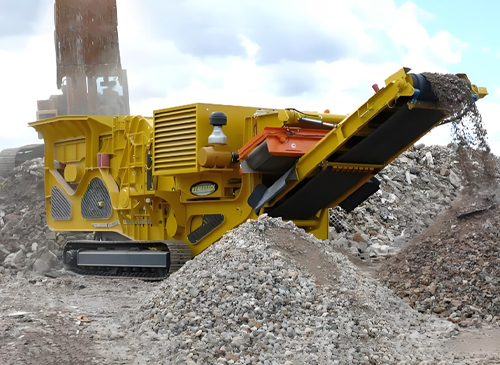
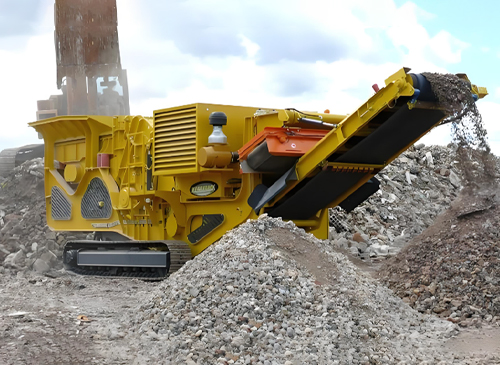 Crawler Mobile Crushing and Screening PlantTracked mobile crushing plant for road, rail and demolition work where frequent relocation and lower permitting lead times matter.View Product →
Where a tracked spread earns its premium is in the pattern of work that shifts every few months: a highway upgrade that advances along a corridor, a demolition contract with several city-centre sites, a quarry working separate benches with different rock. The tracked unit follows the work, the loader run stays short, and no concrete is ever poured.
Where it fails to earn its premium is a single deposit worked for a decade with a stable face. In that case the machine spends 95% of its life standing still, and the buyer has paid for an undercarriage that never turns.
Output and product shape: what changes when the plant moves
Given equal installed power, a stationary line will normally deliver 10%–20% more tonnes per hour than a mobile unit of the same nominal size. The reasons are structural rather than promotional. A fixed plant receives steady, surge-controlled feed from a bin or stockpile; a mobile plant is fed directly by a loader, which means the crusher sees gaps, oversize slugs and clay pockets that the fixed plant's feeder would have smoothed out.
Chamber design also plays a part. Stationary crushers are often built on a heavier frame with a larger feed opening for the same throughput, so bridging and blocking happen less often. Mobile units trade some of that margin for transport dimensions and weight limits.
Product shape, on the other hand, is decided by the crushing principle and the circuit, not by the chassis. A cone crusher in closed circuit produces the same cubical aggregate whether it sits on concrete or on tracks. An impact crusher produces the same high fines content in either configuration. When the feed is abrasive granite or basalt and the specification calls for a tight flakiness index, a properly sized hard rock cone crushing unit in the final stage does more for the product than any change of undercarriage.
What does change is the ability to grow. A stationary plant can add a tertiary stage, a sand washing module or a dry screening deck as demand grows, because there is space and structural capacity to bolt it on. A mobile plant is a closed package: when the market wants a second product size or washed sand, the usual answer is a second machine, not an upgrade.
Feed size is the other hard boundary. Mobile primary units typically accept 500–700 mm depending on model, which suits most quarry blasts and demolition debris. Where run-of-mine feed regularly exceeds 800 mm, the jaw that can take it is very often too heavy to mount on a chassis at economic cost, and the stationary option becomes the practical one.
Wheel-mounted and modular plants: the middle ground that sometimes is not worth it
Wheel-mounted plants suit a specific operating pattern: the same aggregate specification produced at three or four deposits over five years, each site held on a short lease. The chassis allows the unit to be towed between sites on public roads with the right permits, and the setup time is measured in days rather than weeks.
Modular plants are the opposite compromise. They are stationary in everything but the foundations — bolted steel frames, pre-wired control panels, pre-piped conveyors — and they exist to remove civil work from the schedule, not to make the plant movable as a routine matter. A modular line can be dismantled and re-erected, but plan on two weeks and a crane, not two days and a truck.
The trap with both is buying mobility that is never used. A wheeled plant that stays on one site for eight years costs more per tonne than the stationary alternative, and it carries the maintenance burden of axles, brakes, suspension and outriggers that generate no revenue. Ask honestly how many times the plant will move in five years. If the answer is zero or one, the premium is not justified.
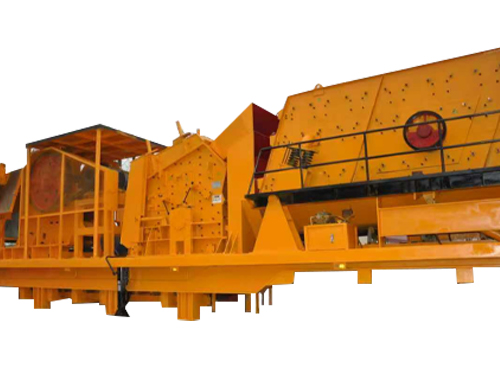 Tire-Mounted Mobile Crushing and Screening PlantWheel-mounted crushing plant for quarries and construction waste where frequent in-site repositioning and short loader cycles justify mobility.View Product →
Wheel-mounted spreads come into their own on jobs where the plant must be repositioned inside the same site: a long borrow pit, a rail ballast contract along a corridor, or a quarry where the working face advances faster than the haul road can be extended. In those cases the move takes hours rather than days and the loader cycle stays short, which shows up directly in cost per tonne.
What to verify on a wheeled quotation
- Axle load and overall transport height with the hopper folded — these decide whether the unit needs a low-loader and an escort.
- Outrigger footprint and ground bearing pressure, because a soft yard will need a prepared pad.
- Whether the crusher discharge conveyor can be folded independently of the screen module.
- Whether the electrical panel is pre-wired for a second conveyor, since retrofitting cables on site is slow.
Five situations where a stationary plant still wins outright
Stationary equipment is not a legacy choice. There are five operating conditions in which it is simply the correct engineering answer, and a mobile plant bought against them will underperform from the first week.
- Deposit life beyond ten years with two or three shifts. The civil cost is amortised across millions of tonnes and stops being a factor.
- Stable grid power under roughly USD 0.10 per kWh. The energy advantage compounds every operating hour and typically covers the extra civil spend within three years.
- Feed size above 800 mm from the blast. A primary jaw that can swallow that material is more economically installed on a foundation than on a chassis.
- Tight multi-product specifications. Three or four calibrated aggregate sizes plus manufactured sand are far easier to hold on a fixed circuit with dedicated screens and bins.
- Plans to add washing, sand making or grinding later. A full aggregate production line can be extended stage by stage; a mobile package cannot.
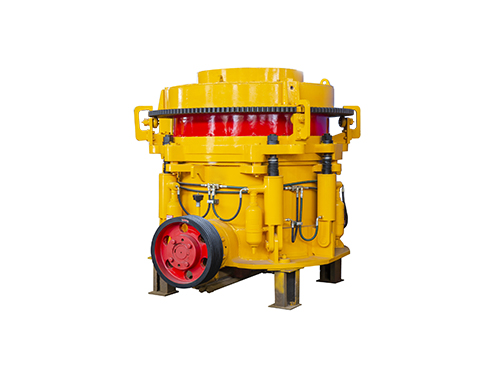 Multi-Cylinder Hydraulic Cone Crusher for Hard StoneMulti-cylinder hydraulic cone crusher for stationary secondary crushing where adjustable closed-side setting balances reduction ratio and throughput.View Product →
In a fixed circuit, the secondary cone is usually the bottleneck that decides whether the plant reaches its nameplate tonnage. A multi-cylinder hydraulic unit with adjustable closed-side setting and hydraulic clearing lets the operator trade reduction ratio against throughput without changing liners, which matters when the market shifts from 20 mm base material to 10 mm chips within the same season.
Fixed plants also make it far easier to control dust and noise at the source, which increasingly decides whether a site keeps its operating permit. Enclosures, water sprays and bag filters are straightforward to design into a permanent structure and awkward to bolt onto a moving chassis.
From order to nameplate output: the timeline that surprises buyers
Delivery dates on paper rarely reflect when a plant actually produces saleable aggregate. The realistic sequence for each configuration looks like this.
The ramp-up curve is where the schedule difference really bites. A mobile plant usually hits 80% of rated capacity within the first week, because the feed arrangement and the discharge conveyors were tested together at the factory. A stationary plant often takes two to four weeks to reach nameplate, as conveyors are aligned, chutes are modified and the control logic is tuned against real material.
For a contractor whose revenue starts when the first tonne is sold, those weeks have a cash value that rarely appears in the quotation comparison. Four extra weeks of commissioning on a 250 t/h plant, at 2000 operating hours a year, is roughly 38,000 tonnes of unsold production.
A five-year total cost model with real numbers
Here is an illustrative model for a 250 t/h two-stage duty on medium-hard limestone, 2000 operating hours a year, 500,000 tonnes annual output, grid power at USD 0.10 per kWh and diesel at USD 1.20 per litre. It is a planning tool, not a quotation.
- Stationary: equipment USD 780,000 plus civil USD 180,000 plus erection USD 70,000 = USD 1.03 million. Energy at USD 0.15 per tonne and labour at USD 0.06 per tonne = USD 105,000 a year.
- Wheel-mounted: equipment and setup USD 1.29 million. Energy at USD 0.20 per tonne and labour at USD 0.05 per tonne = USD 125,000 a year.
- Crawler on site power: equipment USD 1.50 million. Energy at USD 0.22 per tonne and labour at USD 0.04 per tonne = USD 131,000 a year.
- Crawler on diesel: equipment USD 1.49 million. Fuel at roughly USD 1.40 per tonne and labour at USD 0.04 per tonne = USD 721,000 a year.
Over five years without a single move, the stationary option comes in near USD 1.55 million, the wheeled option near USD 1.92 million, the grid-connected crawler near USD 2.21 million, and the diesel crawler past USD 5 million. On those assumptions the fixed plant wins decisively.
Now rebuild the same model with one site move per year. The stationary plant pays roughly USD 250,000 in new civil works and erection each time, adding about USD 1 million over five years and reaching USD 2.56 million. The wheeled plant spends about USD 12,000 per move and lands near USD 1.98 million. The grid-connected crawler spends around USD 8,000 per move and lands near USD 2.25 million.
The ranking flips. That single variable — moves per year — explains most of the disagreement between buyers who insist mobile plants are cheaper and buyers who insist they are not. Both are right, on their own sites.
Purchase checklist before the deposit is signed off
Most costly mistakes in this category are made before any quotation is requested. Work through these points in order and the configuration mostly chooses itself.
Two further items deserve a line in the budget. First, mobile equipment moving between sites on public roads may need transport permits, escorts and route surveys, and those costs recur every time the plant relocates. Second, mobile plants are exposed to weather in a way that fixed plants under a structure are not, which shows up in electrical faults and in operator productivity during wet seasons.
Common buying errors in mobile versus stationary decisions
- Comparing machine prices instead of installed cost per tonne per hour. The quotation with the lower crusher price often carries the higher civil and erection bill.
- Assuming a mobile plant is automatically cheaper because it needs no foundations. The avoided civil cost is usually smaller than the chassis premium on the same duty.
- Assuming a stationary plant is automatically cheaper per tonne. It is, provided the site outlives the payback. Rebuilding it once destroys the advantage.
- Buying the largest mobile unit that fits the budget. Oversized tracked plants burn fuel on idle and cannot be fed fast enough from a single face.
- Ignoring the feed arrangement. A mobile plant fed by an undersized loader will never reach nameplate, regardless of what the crusher datasheet says.
- Underestimating commissioning time on fixed plants. Chute modifications and control tuning consume weeks that the schedule rarely allows for.
One practical habit separates good buyers from disappointed ones: they ask the supplier for the plant's performance at the actual feed size distribution, not at the brochure's ideal curve. Both mobile and stationary equipment is rated on graded, dry, free-flowing rock. Real quarries deliver something else, and the honest supplier will say so.
Frequently asked questions
Is a mobile crushing plant more expensive than a stationary one?
Per tonne of installed hourly capacity, yes — typically 25% to 45% more once the chassis, hydraulics and on-board controls are counted, though the fixed plant's foundations narrow that gap. Whether it is more expensive over the life of the project depends almost entirely on how many times the plant moves.
How long does it take to relocate a crushing plant?
A crawler unit can be working again within hours of arriving on the new bench. A wheel-mounted plant needs two to three days including levelling and alignment. A stationary plant is effectively rebuilt, which means weeks of civil work and erection, and should be treated as a new project rather than a relocation.
Can a mobile plant match the product quality of a fixed plant?
Yes, if the crushing circuit is specified correctly. Product shape is governed by the crusher type and the closed-circuit arrangement, not by the undercarriage. What mobile plants struggle with is holding four or more calibrated sizes simultaneously, simply because there is no room for the extra screens and bins.
Do mobile plants consume more energy per tonne?
They can, mainly because of how the power is generated. A crawler running on its own diesel generator may use two to three times the energy per tonne of a grid-connected stationary plant. A crawler connected to site power closes most of that gap.
What capacity can a wheel-mounted plant realistically reach?
Most wheeled spreads operate between 80 and 300 t/h. Above roughly 300 t/h the chassis and axle restrictions make tracked or stationary configurations more practical, and the transport permits become a recurring burden.
Which configuration suits construction and demolition waste?
Tracked or wheeled equipment almost always suits demolition and recycling work, because the material source changes location and often contains rebar, which needs a magnet and a plant that can be repositioned quickly. Fixed recycling lines make sense only where a single yard receives material for many years.
Can a modular plant be converted to a fully stationary one later?
Usually yes. Modular steel frames can be transferred onto concrete footings and the control panels re-used, which makes modular a reasonable first step for operators who expect to build a permanent yard once permits are granted.
What is the single most useful question to ask a supplier?
Ask for the operating cost per tonne at your own feed gradation and your own power price, including wear parts. Any supplier who answers with rated tonnage and motor power alone has answered a different question than the one that decides the purchase.