English
 русский
Content
- 1 Understanding Sand Washing Machine Technology and Industrial Importance
- 2 Classifications and Working Principles of Sand Washing Equipment
- 3 Application Scenarios and Material Adaptability
- 4 Technical Specifications and Evaluation Metrics for Procurement
- 5 FAQs: Technical Insights and Buyer Concerns
- 5.1 What is the primary difference in water consumption between a wheel sand washer and a screw sand washer?
- 5.2 How does a sand screening and washing machine prevent the loss of fine sand (-0.075mm particles)?
- 5.3 Can a small sand washing machine handle heavy clay contamination effectively?
- 5.4 What are the key maintenance protocols to extend the lifespan of a sand screw washer's bearing system?
- 5.5 How do you choose the right power rating for a river sand washing machine based on moisture content?
- 6 References and Technical Standards
Understanding Sand Washing Machine Technology and Industrial Importance
In modern aggregate production and mineral processing, the sand washing machine serves as the critical definitive stage for quality control. Raw sand excavated from natural sources or produced via mechanical crushing invariably contains deleterious materials such as silt, structural clay, organic loam, and micro-fine dust. Without the intervention of specialized sand washing equipment, these contaminants remain adhered to the aggregate surfaces, directly compromising the structural integrity of downstream construction materials.
From a civil engineering perspective, excess clay and micro-fines (-0.075 mm particles) drastically increase the water demand of concrete mixes. This distortion of the water-cement ratio leads to high shrinkage, reduced compressive strength, and poor freeze-thaw durability. International standards, such as ASTM C33 (American Society for Testing and Materials) and EN 12620 (European Standard for aggregates), enforce strict limitations on the allowable mass percentage of passing fines. Deploying an industrial-grade sand washing machine ensures that the final aggregate gradation aligns perfectly with these global compliance frameworks, optimizing the bond strength between the cement paste and the aggregate interface.
Classifications and Working Principles of Sand Washing Equipment
Industrial washing operations rely on distinct mechanical behaviors to separate clay from sand. The choice of sand washing equipment depends heavily on the contamination level, particle size distribution, and water availability.
Wheel Sand Washer
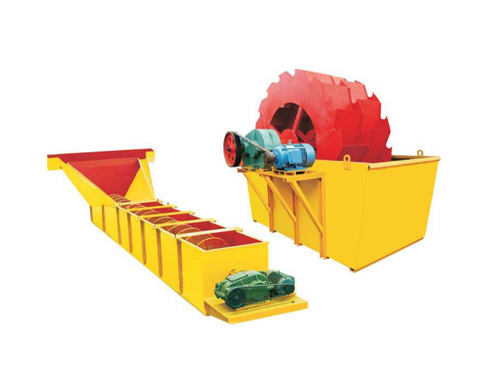
The wheel-type sand washing machine utilizes a rotating bucket wheel driven by an electric motor through a heavy-duty reduction gearbox. The raw material enters the washing tank filled with water. As the impeller rotates slowly, the sand particles frictionally collide with each other, breaking the surface tension of attached mud and rinsing away foreign matter.
The buckets then lift the washed sand from the fluid pool. As the wheel ascends, water drains back into the tank through specialized polyurethane mesh screens lining the buckets, leaving a dewatered, clean product. This configuration minimizes water consumption and is highly efficient for coarse sand processing where the loss of fine material must be strictly controlled.
Spiral Sand Washing Machine (Screw Sand Washer / Sand Screw Washer)
For materials with high plasticity index clay or stubborn mud balls, a spiral sand washing machine (commonly referred to as a screw sand washer or sand screw washer) is required.
This equipment features an inclined trough containing one or two longitudinal shafts fitted with continuous or segmented steel flights. The raw feed is introduced at the lower end of the incline, while clean wash water is injected from the upper end, creating a counter-current washing action.
The mechanical screw transport mechanism actively scrubs and shears the material as it conveys the aggregates upward against the descending water flow. This intensive scrubbing action makes the sand screw washer superior to wheel washers when processing heavily contaminated material, though it demands a higher power input and greater water volume.
Sand Screening and Washing Machine
When raw material has a highly erratic particle size distribution, a unified sand screening and washing machine is deployed. This integrated system combines a high-frequency vibrating screen or an industrial trommel screen directly above or inline with a sand washing unit.
The screening deck removes oversize boulders, trash, and uncrushed debris before the material enters the fluid washing stage. By combining sizing and washing into a single, synchronized structural chassis, this configuration optimizes the material flow circuit, reduces intermediate conveyor requirements, and lowers total plant footprint.
Technical Parameter Comparison Matrix
| Technical Parameter | Wheel Sand Washer | Spiral Sand Washing Machine (Screw Type) |
| Silt/Clay Handling Capacity | Low to Moderate (less than 5% clay content) | High to Heavy (Up to 15%+ clay/mud balls) |
| Fine Sand Retention (-0.075mm) | High retention rate, minimal fines loss | Moderate loss (requires downstream recovery) |
| Water Consumption per Ton | 1.0 - 1.5 cubic meters | 2.0 - 3.5 cubic meters |
| Power Consumption Ratio | Lower (0.15 - 0.25 kW/t) | Higher (0.45 - 0.65 kW/t) |
| Equipment Footprint | Compact, vertical orientation | Long, linear horizontal/inclined footprint |
| Primary Wear Components | Mesh screens, bucket liners | Spiral flights, internal shoes, seals |
Application Scenarios and Material Adaptability
River Sand Washing Machine
Natural river silt presents distinct challenges to aggregate processing, as it often carries lightweight organic contaminants such as root fibers, decomposed leaves, and coal particles, alongside highly sticky river mud layers. A specialized river sand washing machine must be configured with specific gravity separation features, typically utilizing adjustable overflow weirs.
As the raw river sand enters the washing chamber, high-volume water currents float off the low-density organic matter, allowing it to spill over the weir into waste flumes. Concurrently, the heavier, high-purity silica sand settles to the bottom of the tub, where it is mechanically engaged by the wheel or screw transport system for deep rinsing and dewatering.
Small Sand Washing Machine Solutions for Compact Operations
Not all quarrying and mineral extraction projects justify massive, permanent concrete infrastructure. For localized infrastructure projects, short-term mining leases, or mobile recycling operations, a skid-mounted or track-mounted small sand washing machine provides the necessary processing agility.
These compact units are engineered for rapid deployment, typically requiring a lower total power consumption of 5.5 - 15 kW while delivering structured, reliable washing performance in the range of 15 - 30 t/h. Their modular framework allows them to be transported easily via standard freight trucks, eliminating the need for complex foundation civil engineering on temporary sites.
Tailoring the Complete Sand Washing Unit for Manufactured Sand (M-Sand)
With the depletion of high-quality natural river sand reserves, the global construction market relies increasingly on Manufactured Sand (M-Sand) produced by crushing granite, limestone, basalt, or cobble. However, the mechanical crushing process generates an excess of dry stone dust (filler particles passing through a 75 micrometer sieve), which can compromise the quality of concrete if it exceeds 10% - 15% of the total aggregate volume.
A complete, closed-loop sand washing unit for M-Sand does not operate with a standalone washer; it integrates a sand washing machine, a slurry pump, a hydrocyclone separator, and a high-frequency dewatering screen into a unified system circuit. The washing machine strips the heavy mud and separates the mass of stone dust, while the hydrocyclone recaptures the valuable 0.075 mm - 0.16 mm fine micro-sand from the waste sludge water. This recaptured fine material is then discharged back onto the dewatering screen to blend with the coarse sand, optimizing the sand gradation curve while achieving dry-tailings waste disposal.
Technical Specifications and Evaluation Metrics for Procurement
Procuring an industrial-grade sand washing machine requires a precise evaluation of mechanical limits and material engineering standards to guarantee long-term operational stability under harsh mining and quarrying conditions.
Throughput Capacity and Volumetric Slurry Ratios
Processing capacity must never be calculated solely on dry solid tonnage per hour (t/h). It must be cross-referenced with the maximum volumetric water flow (cubic meters per hour) and the expected slurry density. Overloading a sand washing equipment setup beyond its volumetric design limits increases the fluid velocity within the settlement tank. This high-velocity turbulence causes immediate, unintended overflowing of valuable fine sand particles into the waste ponds, disrupting the target aggregate gradation curve.
Structural Material Selection and Wear Protection
Due to the highly abrasive nature of high-velocity silica sand particles, specific wear zones within the sand washing unit must be structurally armored:
Tub Construction: The main washing tank and chassis should feature heavy-wall structural carbon steel, with plate thicknesses typically ranging from 10 mm to 16 mm to prevent structural warping and erosion over years of continuous operation.
Screen Media: Polyurethane screen panels are preferred over traditional woven wire mesh for dewatering zones. Polyurethane offers an operational lifespan that is 5 to 8 times longer and maintains a consistent opening slot size under high impact.
Flight Protection: For a sand screw washer, the outer edge of the spiral flights is the primary wear point. These flights must be fitted with replaceable high-chromium alloy wear shoes (such as Cr26 or Cr28) or thick, modular polyurethane liners. This ensures that the core structural steel of the spiral shaft is completely protected from direct material friction.
Transmission Integrity and Bearing Isolation Systems
The main bearing assembly is the most critical single point of failure in any sand washing equipment. Because these machines run continuously in water and fine abrasive grit, standard seals are insufficient.
The bearing housing must be physically isolated from the washing tank using a combination of heavy-duty mechanical face seals, multi-lip rubber radial seals, and dedicated external grease purging channels. This arrangement allows operators to pump fresh grease into the assembly, forcing any intruding micro-grit outward away from the internal roller components. Furthermore, the reduction gearboxes must utilize precision-ground helical gears with a service factor greater than or equal to 1.5 to withstand the high starting torques encountered when the washing tub is fully loaded with settled material.
FAQs: Technical Insights and Buyer Concerns
What is the primary difference in water consumption between a wheel sand washer and a screw sand washer?
A wheel-type sand washing machine operates by scooping material out of a settled pool, consuming roughly 1.0 - 1.5 cubic meters of water per ton of sand processed. This efficiency is achieved because gravity drainage occurs within the buckets before the material is discharged. In contrast, a sand screw washer pushes material up an inclined trough against a continuous, descending counter-current wash stream. This requires a higher water ratio of 2.0 - 3.5 cubic meters per ton to maintain proper material fluidization and suspend heavy clay particles.
How does a sand screening and washing machine prevent the loss of fine sand (-0.075mm particles)?
To prevent the loss of critical fine sand during high-volume rinsing, modern integrated sand screening and washing machine systems link the overflow weir of the washing tank directly to a fine sand recovery loop. This system utilizes a heavy-duty slurry pump to extract the overflow wastewater and feed it into a hydrocyclone separator. The centrifugal forces separate the usable micro-sand (0.075 mm - 0.16 mm) from the ultra-fine waste mud, discharging the reclaimed fines back onto a dewatering screen to be blended uniformly with the coarse sand product.
Can a small sand washing machine handle heavy clay contamination effectively?
A small sand washing machine can process clayed materials, but its structural configuration determines its efficiency. A compact wheel washer has a relatively short material retention time in the water, making it inefficient against sticky, highly plastic clay or hard mud balls. If a compact operation faces heavy clay contamination, it is technically superior to utilize a small, single-shaft screw sand washer, which provides the prolonged mechanical shearing and scrubbing needed to break down clay binders.
What are the key maintenance protocols to extend the lifespan of a sand screw washer's bearing system?
The lower submerged bearing assembly of a screw sand washer requires a daily injection of high-pressure lithium-base grease while the equipment is in operation. This creates a positive, outward pressure seal that forces away any intruding micro-grit. Additionally, the main reduction gearbox must undergo an initial lubricant change after the first 100 hours of break-in operation, followed by regular, scheduled oil replacements every 1,000 operational hours to prevent gear wear from metal particulates.
How do you choose the right power rating for a river sand washing machine based on moisture content?
Power rating calculations are driven by total material mass and mechanical resistance rather than the initial moisture content of the raw material. High silt or clay content increases the viscosity of the slurry within the washing tank, which creates significantly higher mechanical drag on the rotating impellers or spiral flights. When processing heavy river deposits, electric motors should be specified with a power margin approximately 15% - 20% above standard baseline ratings to safely handle high-torque startup conditions when the tub is fully loaded with settled aggregate.
References and Technical Standards
ASTM C33 / C33M: Standard Specification for Concrete Aggregates.
EN 12620: Aggregates for Concrete (European Standard).
Wills' Mineral Processing Technology: An Introduction to the Practical Aspects of Ore Treatment and Mineral Recovery.
SME Mineral Processing and Extractive Metallurgy Handbook: Section on Size Classification and Washing Infrastructure.